


Canine Atopic Dermatitis in Spring — What Border Collie Owners Need to Know
The Spring Itch: Why Veterinary Dermatology Clinics Fill Up in April
Walk into a veterinary dermatology clinic in spring, and you’ll likely find a waiting room full of itchy dogs. The overlap with cedar and cypress pollen season is no coincidence. Complaints such as “he started scratching furiously around March,” “she won’t stop licking her paws,” and “the ears are inflamed again” represent the textbook spring exacerbation of canine atopic dermatitis (CAD).
CAD is one of the most common conditions in veterinary dermatology, estimated to affect 3–15% of all dogs worldwide (Hillier & Griffin, Veterinary Immunology and Immunopathology, 2001). For Border Collies — who spend long hours outdoors, crossing meadows, riverbeds, and mountain trails — the spring allergen season demands attention and a clear management plan.
Border Collies and CAD Risk: What the Data Says
The data may surprise you: Border Collies are statistically a low-risk breed for CAD.
A cross-continental study covering 15 countries across five continents found that Border Collies have an odds ratio (OR) of 0.31 (95% CI: 0.11–0.84), placing them as a statistically significant low-risk breed (Nuttall et al., Veterinary Dermatology, 2019, PMID: 30370576).
By comparison, high-risk breeds include:
- West Highland White Terrier
- Boxer, Bulldog
- Labrador Retriever, Golden Retriever
- French Bulldog
That said, low breed-level statistical risk does not mean zero risk at the individual level. Border Collies have several breed-specific factors that can elevate personal susceptibility:
- High outdoor exposure: Field work, trail running, and river access mean significantly greater contact with pollen, mold spores, and grass plants compared to the average companion dog
- Double coat characteristics: Dense undercoat retains moisture and heat, creating favorable conditions for secondary infections by Staphylococcus pseudintermedius and Malassezia pachydermatis
- Filaggrin (FLG) gene variants: The most important genetic risk factor for CAD in dogs. FLG mutations lead to impaired keratinocyte formation, increased transepidermal water loss (TEWL), and percutaneous allergen sensitization (Marsella et al., Veterinary Dermatology, 2011, PMID: 21414049)
Spring–Summer Allergen Calendar
Understanding which allergens peak when is fundamental to managing seasonal CAD.
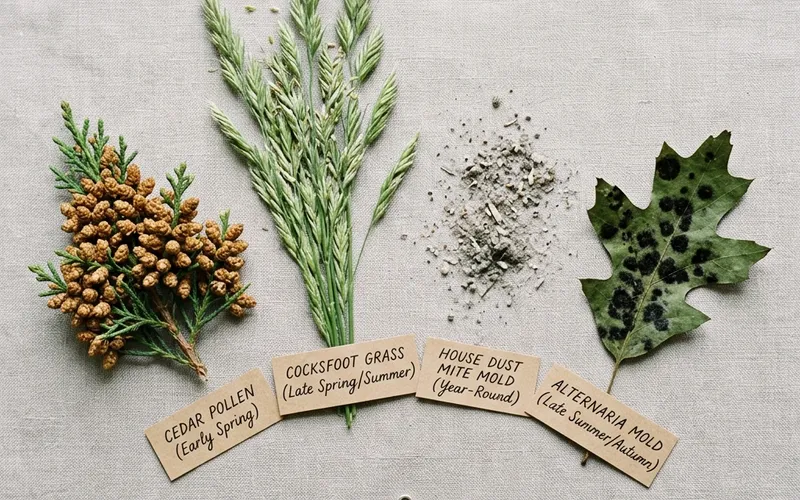
| Month | Primary Allergens | Notes |
|---|---|---|
| Feb–Apr | Japanese cedar pollen | Japan’s most prevalent aeroallergen. Wind-dispersed, high volume |
| Mar–May | Japanese cypress pollen | Overlaps with cedar; affects central to southern Japan |
| May–Jul | Grass pollen (Cocksfoot/Dactylis, etc.) | Direct contact risk during field exercise |
| Year-round (peaks Jun–Aug) | House dust mites (HDM) | Globally, the single most important allergen in CAD |
| Spring and fall | Mold spores (Alternaria, etc.) | Found both outdoors and indoors |
A direct correlation between indoor HDM concentration and symptom severity has been demonstrated (PMC9932715). Spring is particularly challenging because pollen and mite loads peak simultaneously.
Diagnosis: The Favrot Criteria
A positive allergy test alone does not confirm CAD. The current global standard for clinical diagnosis is the Favrot Criteria (Favrot et al., Veterinary Dermatology, 2010, PMID: 20187911).
When 5 or more of the following 8 criteria are met, CAD is identified with approximately 80% sensitivity and 79–85% specificity:
- Onset of symptoms at or before 3 years of age
- Dog lives mostly indoors
- Glucocorticoid-responsive pruritus (initially)
- Affected forefeet and/or hindfeet
- Affected ear pinnae
- Ear margins are NOT affected
- Dorsal lumbar region is NOT affected
- Recurrent secondary yeast infections
Key caveat: The Favrot criteria are a diagnostic aid, not a gold standard. Definitive diagnosis requires ruling out food allergy, flea allergy dermatitis, and other pruritic conditions.
Distinguishing Environmental Allergy from Food Allergy
Skin lesions alone cannot reliably separate CAD from food-induced allergic skin disease. The following factors help guide clinical decision-making:
| Feature | CAD (Environmental) | Food Allergy |
|---|---|---|
| Seasonality | Often present | Perennial, non-seasonal |
| GI signs | Typically absent | Diarrhea/vomiting in ~30% |
| Confirmation | Allergen testing + exclusion | Elimination diet trial (≥8 weeks) |
The elimination diet trial using a novel protein or hydrolyzed diet for at least 8 weeks remains the gold standard for confirming food allergy. A subsequent rechallenge with the original diet is required for definitive confirmation (AAHA Allergic Skin Disease Guidelines, 2023).
The Skin Barrier Failure Cascade
To understand CAD, the concept of skin barrier failure is essential.
In healthy skin, the stratum corneum (outermost skin layer) forms a dense lipid matrix — primarily ceramides — that blocks environmental allergens, pathogens, and irritants. In dogs with CAD, ceramide content in the stratum corneum is significantly reduced (Yoon et al., 2013).
The resulting cascade:
- Ceramide depletion → gaps in the stratum corneum
- Increased TEWL → skin becomes chronically dry
- Percutaneous penetration of pollen fragments and mite allergens → immune overreaction
- Scratching and self-trauma → further barrier destruction
- Secondary bacterial and yeast infection → worsened inflammation and more itch
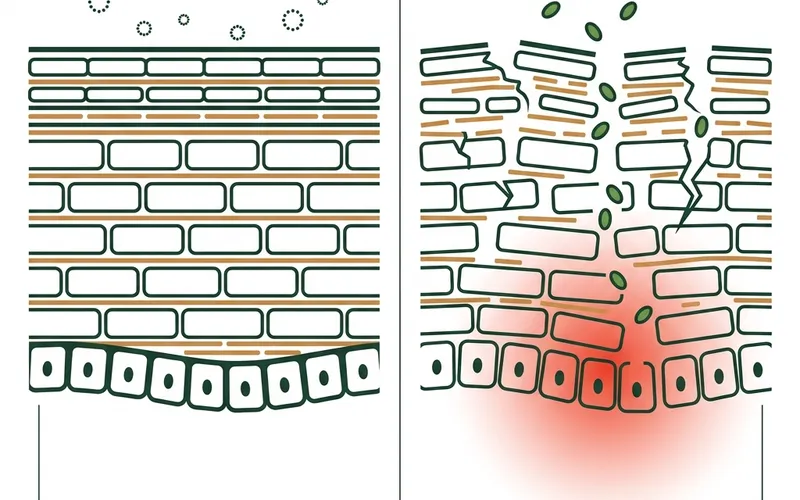
Interrupting this cycle is the central challenge of CAD management.
Treatment Options
1. Controlling Acute Pruritus
Oclacitinib (Apoquel) A JAK1/3 inhibitor that attenuates signaling of IL-31 and other pruritogenic cytokines. Itch reduction begins within 4 hours of administration. Long-term safety has been well-established through over a decade of post-marketing data (JAVMA, 2023). Available as a once- or twice-daily oral tablet, making at-home management straightforward.
Lokivetmab (Cytopoint) An anti-IL-31 monoclonal antibody administered by subcutaneous injection once monthly. Reported efficacy (≥50% improvement) ranges from 73–88% (PMC11938560). It can be effective in cases where Apoquel provides insufficient response. The requirement for monthly veterinary visits is the primary limitation.
Glucocorticoids (steroids) Remain effective for acute itch control. Long-term use carries risks including iatrogenic hyperadrenocorticism. With the availability of Apoquel and Cytopoint, the trend is toward steroid-sparing treatment protocols.
2. Restoring Skin Barrier Function
The optimal ratio for skin barrier repair formulas is ceramide:cholesterol:fatty acids = 3:1:1 (dvm360, 2022). A 4-week clinical trial using ceramide-based shampoo plus moisturizing cream demonstrated significant improvements in skin hydration, reduced TEWL, and restored lipid lamellar structure (Park et al., Journal of Veterinary Science, 2013, PMC3694192).
Active ingredients with veterinary evidence include:
- Ceramides (NP, AP, EOP)
- Phytosphingosine
- Colloidal oatmeal
- Hyaluronic acid
- Borage oil
3. Allergen-Specific Immunotherapy (ASIT)
ASIT is the only disease-modifying therapy available for CAD — meaning it targets the underlying immune dysregulation rather than suppressing symptoms. In a retrospective study of 664 dogs receiving subcutaneous ASIT (SCIT), the response rate (≥50% improvement) was 59.9%, with excellent responses in 31.5% (PMC9544551). A 2023 JAVMA systematic review confirmed ASIT as a recommended treatment for CAD.
Important characteristics:
- Effect onset: 6–12 months after initiation
- Administered as a series of subcutaneous injections with increasing allergen doses
- Avoidance of long-term steroids during the first 9 months improves response rates
- Side effects are generally mild (local injection site reactions)
For owners seeking to reduce long-term pharmacological dependence, ASIT represents the most evidence-backed path.
4. Omega-3 Fatty Acids as Adjunct Therapy
EPA/DHA supplementation occupies an adjunct role in CAD management. A double-blind, placebo-controlled RCT demonstrated a significant reduction in CADESI-4 scores after 60 days on an EPA/DHA-enriched diet (PMC8603501), with 65% of dogs showing notable pruritus reduction. Omega-3s do not produce remission alone, but they can reduce required drug doses when combined with first-line treatment.
Measuring Severity: CADESI-4
Tracking treatment response requires objective measurement. The CADESI-4 (Olivry et al., Veterinary Dermatology, 2014) evaluates skin lesions across 20 body sites, scoring three parameters (erythema, lichenification, alopecia/excoriation) from 0–3, with a maximum of 180 points.
| Score | Severity |
|---|---|
| ≤10 | Mild |
| ≤35 | Moderate |
| ≥60 | Severe |
Recording CADESI-4 scores at regular intervals allows owners and clinicians to evaluate whether a chosen treatment protocol is delivering measurable results.
Spring Care Protocol
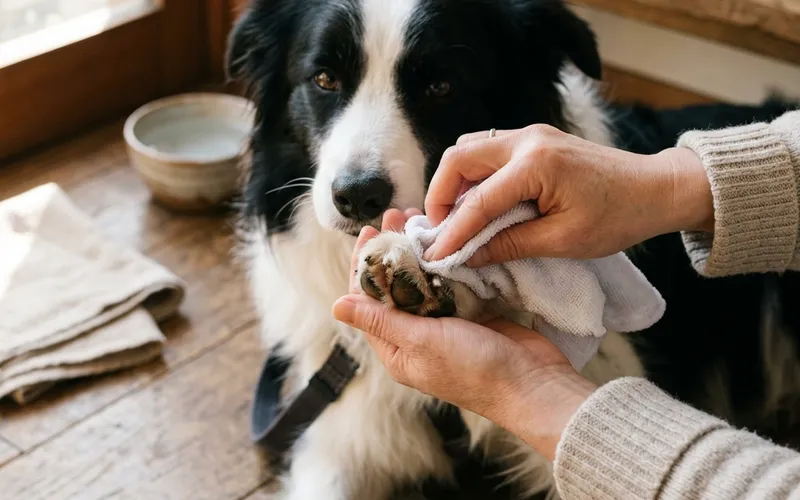
Post-Walk Allergen Removal
- Wipe paws, abdomen, and ear folds with a damp cloth immediately after outdoor activity (reduces percutaneous allergen sensitization)
- If foot-washing, apply moisturizer after drying (avoid stripping skin lipids through over-washing)
Adjusting Exercise Routes (May–July)
Grass fields dominated by Cocksfoot (Dactylis glomerata) and other Poaceae reach peak pollen production in May–July. Shifting walks to paved paths or well-maintained parks during peak season meaningfully reduces allergen load.
Indoor House Dust Mite Control
- HEPA air purifier in the dog’s sleeping area
- Wash dog bedding weekly at ≥140°F (60°C)
- Vacuum while the dog is in another room
- Keep relative humidity below 50% (use a dehumidifier during rainy season)
Shampoo Frequency and Formulation
For atopic dogs, shampooing 1–2 times per week is recommended. The dual goals are allergen removal and barrier restoration. Ceramide-containing products with evidence-backed ingredients are preferable, and a follow-up moisturizer applied after rinsing improves outcomes (ICADA 2015 Guidelines).
The Gut-Skin Connection
Emerging research has drawn attention to the gut-skin axis: the idea that dysbiosis — an imbalance in gut microbiota — compromises intestinal barrier integrity, leads to systemic immune dysregulation, and exacerbates skin inflammation. Multiple studies are building evidence for this pathway, and early-life microbiome development appears to influence later CAD risk (Scientific Reports, 2020, high-risk breed cohort study).
Optimizing dietary omega-6:3 ratios and considering targeted probiotic supplementation may support long-term skin health. That said, the evidence for probiotics in canine CAD remains preliminary — promising but not yet definitive.
The science keeps advancing. The management keeps improving. Know the mechanisms, track the scores, and give your dog the best chance at a comfortable life — regardless of the season.
About ROSCH KENNEL: A Border Collie specialist kennel located within Kirishima Kinkowan National Park, Kagoshima, Japan, at an elevation of 750 m (2,460 ft). All breeding dogs undergo 15+ genetic health tests, and results are published in full. The ENS (Early Neurological Stimulation) program is applied to every litter.
References
- Hillier A, Griffin CE. The ACVD task force on canine atopic dermatitis (I): incidence and prevalence. Veterinary Immunology and Immunopathology. 2001;81(3-4):147-151. PMID: 11553375
- Favrot C, et al. A prospective study on the clinical features of chronic canine atopic dermatitis and its diagnosis. Veterinary Dermatology. 2010;21(1):23-31. PMID: 20187911
- Nuttall T, et al. Breed- and site-predispositions of dogs with atopic dermatitis: a comparative and multi-continent study. Veterinary Dermatology. 2019;30(2):89-e26. PMID: 30370576
- Olivry T, et al. Validation of the Canine Atopic Dermatitis Extent and Severity Index (CADESI)-4. Veterinary Dermatology. 2014;25(2):77-e25. DOI: 10.1111/vde.12107
- Marsella R, et al. Current evidence of skin barrier dysfunction in human and canine atopic dermatitis. Veterinary Dermatology. 2011;22(3):239-248. PMID: 21414049
- Park SA, et al. Clinical use of a ceramide-based moisturizer for treating dogs with atopic dermatitis. Journal of Veterinary Science. 2013;14(2):199-205. PMC3694192
- Martínez-Subiela S, et al. Efficacy of subcutaneous allergen immunotherapy in atopic dogs: A retrospective study of 664 cases. Veterinary Dermatology. 2022. PMC9544551
- Olivry T, et al. Treatment of canine atopic dermatitis: 2015 updated guidelines from ICADA. BMC Veterinary Research. 2015;11:210. DOI: 10.1186/s12917-015-0514-6
- AAHA Management of Allergic Skin Diseases in Dogs and Cats Guidelines. 2023.
- Randomized double-blind, placebo-controlled clinical trial measuring the effect of a dietetic food on dermatologic scoring and pruritus in dogs with atopic dermatitis. PMC8603501. 2021.
Daily observation is where the next article begins.
Instagram shows the dogs in daily life. The journal turns the themes we notice there into evidence-aware resources.