
Border Collies and Agility — The Science Behind the Perfect Match, and How to Start Safely
Anyone who lives with a Border Collie has faced the same question eventually: where does all that intelligence and energy actually go? Walks aren’t enough. Fetch sessions feel infinite. The dog is always one step ahead, looking for the next problem to solve.
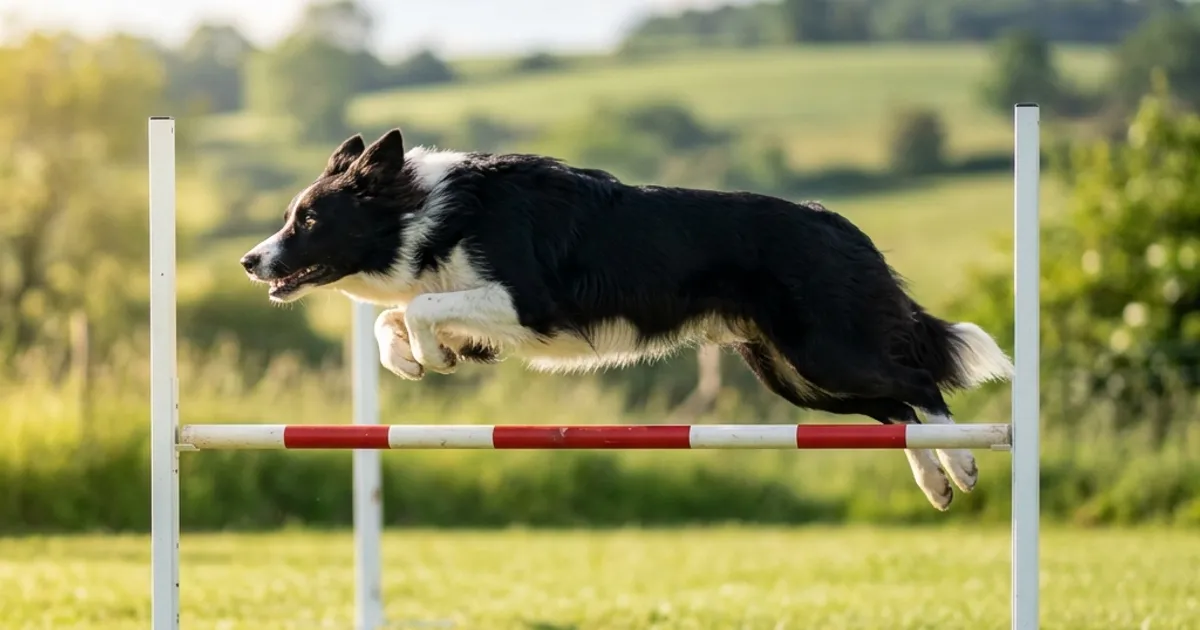
Agility is one of the most compelling answers. Not just a sport — a communication discipline, where handler and dog work in seamless partnership through a timed obstacle course. Hundreds of millions of competitors worldwide. Over 30 sanctioned events per year in Japan alone.
But start wrong, and you risk real harm. Ill-timed jumping practice in young dogs can cause permanent skeletal damage. This article covers what the science actually says about when, how, and why to start agility — safely and effectively.
Why Border Collies Excel at Agility
Psychologist Stanley Coren of the University of British Columbia surveyed 208 obedience trial judges for his 1994 book The Intelligence of Dogs. Border Collies ranked #1 in working and obedience intelligence out of 138 breeds.
The data was specific: the average Border Collie learns a new command in 5 repetitions or fewer and obeys a known command on the first request 95% of the time or better.
This isn’t random. Border Collies were selectively bred over centuries in the borderlands of Scotland and Wales to herd sheep by reading a handler’s whistle signals and body language — then making independent decisions on the fly. Agility, at its core, is the same task: read the handler, read the course, execute with precision and speed.
A 2017 longitudinal study published in PLOS ONE (Tiira & Lohi, PMID: 28184101) followed 69 Border Collies from 6 to 24 months of age. Among the findings: 71.9% were kept for sport purposes including agility, and responsiveness to training improved progressively with age.
How Agility Competition Works
Obstacle Types
Agility obstacles fall into two categories: contact obstacles (where touching a designated zone is mandatory) and non-contact obstacles.
Contact Obstacles
| Obstacle | Description |
|---|---|
| A-Frame | Two panels joined at the peak form an inverted V shape (approx. 5’7” / 1.7m high). Dogs climb and descend both sides. |
| Dog Walk | A raised plank at approximately 4 feet (1.2m) off the ground, consisting of three sections. |
| Seesaw (Teeter) | A pivot board that tilts under the dog’s weight. The dog must wait for full contact before moving on. |
Non-Contact Obstacles
| Obstacle | Description |
|---|---|
| Hurdle / Jump Bar | The most basic obstacle — clear a horizontal bar. |
| Weave Poles | A line of upright poles (20–22 inches / 51–56cm apart) that the dog must thread through in a serpentine pattern. |
| Open Tunnel | A flexible tube, 10–20 feet (3–6m) long, open at both ends. |
| Tire Jump (Ring Jump) | Dog jumps through a suspended ring. |
| Pause Table | Dog must stop on a raised platform and hold a position (typically sit or down) for 5 seconds. |
Contact Zones Explained
The lower section of the A-Frame, Dog Walk, and Seesaw — approximately 40 cm (16 inches) — is painted yellow. Dogs must touch this zone on entry and exit. This rule exists specifically to prevent dogs from leaping off elevated obstacles at full height, reducing the risk of impact injuries on landing.
Competition Structure in Japan
| Organization | Focus | Notes |
|---|---|---|
| JKC (Japan Kennel Club) | Largest; FCI-affiliated | ~30 events/year; World Championship selection |
| OPDES (NPO) | IFCS-WAC system | Frequent events; independent rules |
| JOA (Japan Open Agility) | Independent | Regional competitions available |
JKC classes progress from Grade 1 (novice) through Grade 3. Dogs are divided into size classes based on shoulder height: Small (under 35cm / 14in), Medium (35–43cm / 14–17in), Intermediate (43–48cm / 17–19in), and Large (48cm+ / 19in+).
The Most Important Question: When Is It Safe to Start?
The instinct to begin early is understandable. The evidence suggests caution.
Growth Plates and the Risk of Early Jumping
The long bones of a dog’s limbs contain growth plates (physes) — cartilaginous tissue at the ends of bones that manages longitudinal bone growth. In large breeds, these plates typically don’t close until around 18 months of age.
When a dog lands from a jump with improper form before the growth plates have closed, the cartilage can shear. The result can be permanent limb deformity or shortening — irreversible damage.
The data supports this concern. A landmark 2021 study published in the Journal of the American Veterinary Medical Association (Levy et al., Vol.259, No.9) surveyed agility competitors and found that 41.7% had experienced an injury — up from 32% a decade earlier. The most commonly injured site was the shoulder (30.1%), followed by the iliopsoas muscle (19.4%).
A 2024 study in Animals (MDPI) focused specifically on Border Collies (PMID: 39061542). The findings were sobering:
Border Collies had an injury rate of 51.9% (549 of 1,052 dogs surveyed) — significantly higher than other breeds. Among the significant risk factors identified: starting full-height jumping at a younger age.
Age-Based Guidelines
| Training Activity | Recommended Start Age |
|---|---|
| Basic obedience (recall, stay, eye contact) | 8 weeks+ |
| Flatwork (directional movement with handler) | 8 weeks+ |
| Short, straight tunnels | 4–6 months+ |
| Weave poles (channel method, low intensity) | 6 months+ |
| Jump bars placed on the ground (no height) | 4 months+ |
| Actual jumping at competition height | 18 months+ (recommended) |
| JKC sanctioned competition | 18 months (required by regulation) |
This isn’t a directive to wait and do nothing. It’s an invitation to spend 18 months building everything that doesn’t require height — foundation handling, recall precision, contact zone habits, weave muscle memory. Dogs that arrive at 18 months with this groundwork already in place progress through formal agility training dramatically faster.
Foundation Training: What You Can Build Right Now
1. Rock-Solid Basic Obedience
Agility is a sport of real-time communication between handler and dog. If a “come” command isn’t reliable at 100 meters with distractions, the dog isn’t ready for a course. Three skills must be bulletproof before anything else:
- Recall: The dog stops and returns, no matter what’s in front of it.
- Stay: Reliable in the face of movement, noise, and other dogs.
- Eye contact: The dog checks in with the handler automatically, without being asked.
These aren’t prerequisites that get ticked off once. They require ongoing maintenance at increasing levels of distraction.
2. Flatwork
Before any obstacle is introduced, teach the dog to work with the handler in motion. This means:
- Moving with the handler at varying speeds without drifting
- Turning left and right on handler body cues (not just verbal)
- Changing pace (accelerating when the handler accelerates, decelerating when they slow)
This can be done in any park or field. No equipment needed.
3. Target Training
Teaching the dog to touch a target (a lid, a hand, a specific object) with its nose or paw forms the foundation for contact zone training later. The behavior chain is simple: touch target → reward. But the precision it builds translates directly into reliable, safe contact performance on the A-Frame and Dog Walk.
4. Tunnel Introduction
Tunnels are typically the most enthusiasm-generating obstacle for young dogs. Start with a short, straight section — just long enough for the dog to see through to the other end. Make it a game. The mental association “obstacle = fun” built in the tunnel carries over to every piece of equipment that follows.
5. Weave Poles — The Long Game
Weave poles are widely considered the hardest skill in agility to teach. The serpentine motion is not natural for dogs. Full independent weaving at competition speed can take 6–18 months of consistent work.
Using the channel method — starting with poles spread far apart to form a wide corridor, then gradually narrowing — allows even very young dogs to begin building the movement pattern without excessive physical stress. The earlier this begins (even informally), the more automatic the footwork becomes by the time full training starts.
Physical Conditioning for Agility
Agility places concentrated demands on specific muscle groups: rapid acceleration, abrupt stops, direction changes exceeding 180 degrees, and controlled jumping with precise landings.
A 2022 study in Frontiers in Veterinary Science (PMID: 35873675) identified that iliopsoas injuries — the second most common injury site in agility dogs — are often caused by eccentric muscle contraction during high-speed direction changes and extension movements.
Conditioning methods supported by evidence:
- Balance disks / fitness balls: Strengthens core musculature, particularly the iliopsoas and hindquarter muscle groups
- Cavaletti poles (ground-level grid exercises): Improves stride regulation and proprioception — the dog’s ability to sense where its limbs are in space
- Swimming / water treadmill: Builds cardiovascular capacity with near-zero skeletal impact; also used for post-injury rehabilitation
- Hill walks (gentle inclines): Targets rear-drive muscle development
Cardiovascular benefits have also been reported. Some sources cite 9 weeks of consistent conditioning reducing resting heart rate by 26% and submaximal exercise heart rate by 22%, though independent peer-reviewed verification of this specific figure is limited; it is best treated as a reference estimate rather than an established benchmark.
What Competing Together Does to a Relationship
The benefits of agility extend beyond the dog’s fitness.
A 2017 study in Frontiers in Aging Neuroscience (Bray et al., PMID: 28473766) found that Border Collies with high lifelong training scores performed significantly better on attention tasks than dogs with little training history — suggesting that sustained activity like agility may delay age-related cognitive decline.
Perhaps more striking is what a 2019 study published in Scientific Reports (Sundman et al.) found: long-term cortisol levels in dogs and their owners are synchronized across species. Dogs competing in agility and obedience trials showed stress hormone patterns that mirrored their handlers’ over time. A calm, consistent handler produces a calmer dog. A handler who brings tension to the course will see that tension reflected in performance and behavior.
Competing in agility doesn’t just train the dog. It trains the handler — and the relationship between them.
Before You Begin: What to Check
Before starting agility training, a veterinary consultation is strongly recommended — particularly in the following situations:
- A parent dog has a history of hip dysplasia (HD) or elbow dysplasia (ED)
- The puppy shows any gait irregularity in the hindquarters
- Before beginning full-height jumping (around 18 months)
Agility training assumes a sound skeletal and muscular foundation. A pre-competition screening isn’t excessive caution — it’s protecting an investment that will compound over years of training.
When selecting a trainer, look for someone with specific Border Collie experience who operates from a positive reinforcement framework. The combination of high drive and exceptional intelligence in this breed makes compulsion-based methods counterproductive — they suppress the very initiative that makes Border Collies exceptional agility athletes.
Agility can be a long-term sport only when the dog is physically ready and the handler can make safe decisions.
About ROSCH KENNEL: A Border Collie breeder based in Kirishima, Kagoshima, Japan — in the mountains of Kirishima-Kinkowan National Park at 750m / 2,460ft elevation. All breeding dogs undergo 15+ genetic health tests, with results published in full. ENS (Early Neurological Stimulation) is applied to every litter.
References
- Bray, E.E. et al. (2017). Aging of Attentiveness in Border Collies and Other Pet Dog Breeds: The Protective Benefits of Lifelong Training. Frontiers in Aging Neuroscience. PMID: 28473766.
- Tiira, K. & Lohi, H. (2017). Individual and group level trajectories of behavioural development in Border collies. PLOS ONE. PMID: 28184101.
- Levy, M. et al. (2021). Internet-based survey of the frequency and types of orthopedic conditions and injuries experienced by dogs competing in agility. Journal of the American Veterinary Medical Association (JAVMA), Vol.259 No.9.
- Anonymous (2024). Risk Factors for Injury in Border Collies Competing in Agility Competitions. Animals (MDPI), Vol.14, No.14, Article 2081. PMID: 39061542. PMC: 11273924.
- Anonymous (2022). Internet Survey Evaluation of Iliopsoas Injury in Dogs Participating in Agility Competitions. Frontiers in Veterinary Science. PMID: 35873675.
- Sundman, A-S. et al. (2019). Long-term stress levels are synchronized in dogs and their owners. Scientific Reports (Nature Publishing Group).
- Coren, S. (1994). The Intelligence of Dogs. University of British Columbia.
- FCI (2022). Agility Regulations. Fédération Cynologique Internationale.
- Japan Kennel Club (JKC). Agility Competition Rules. https://www.jkc.or.jp/events/agility/
Daily observation is where the next article begins.
Instagram shows the dogs in daily life. The journal turns the themes we notice there into evidence-aware resources.