


Food Allergies and Skin Disease in Border Collies — Causes, Diagnosis, and the Elimination Diet
A Border Collie whose ears flare up again and again. A dog that can’t stop licking its paws no matter what you try. An allergy blood panel from the vet that came back inconclusive. These experiences are far more common than they should be.
Food allergy is among the most misunderstood conditions in canine dermatology. Misconceptions about how it’s diagnosed — and what causes it — lead many owners down expensive, ineffective paths. This article uses peer-reviewed veterinary literature to clarify what food allergy actually is, how it differs from environmental allergy, and what the science says about diagnosis and management.
Food Allergy vs. Environmental Allergy vs. Food Intolerance
Three distinct conditions frequently get lumped under the label “allergy.” The distinctions matter for both diagnosis and treatment.
| Type | Mechanism | Seasonality |
|---|---|---|
| Food allergy (cutaneous adverse food reaction) | Immune response to specific food proteins | None — year-round |
| Canine atopic dermatitis (CAD) | IgE-mediated and non-IgE-mediated response to environmental allergens (pollen, mites, etc.) | Often seasonal, or perennial |
| Flea allergy dermatitis | Reaction to flea saliva proteins | Peaks in summer/fall |
Food allergy accounts for approximately 20% of all allergic skin disease in dogs; some systematic reviews place adverse food reactions at roughly 6% of all cutaneous conditions (BMC Veterinary Research, multiple systematic reviews). Critically, food allergy and atopic dermatitis look nearly identical clinically — and 9–50% of food-allergic dogs are estimated to have concurrent atopic dermatitis (Verlinden et al., 2006), which makes an already complex diagnosis even harder.
The “Ears and Rears” Pattern
In veterinary dermatology, the classic distribution of food allergy signs is sometimes called the “Ears and Rears” pattern. Knowing this pattern is clinically useful.
Typical affected areas:
- Pinnae (ear flaps) — often presenting as recurrent otitis externa
- Feet and paw pads
- Ventral abdomen
- Perianal and perigenital regions
- Axillae (armpits) and groin
Recurrent external ear infections — especially those responding partially to antibiotics only to return within weeks — can be the earliest sign of an underlying food allergy. Secondary infections with Staphylococcus spp. or Malassezia yeast are common, and if the root cause goes unidentified, the cycle repeats indefinitely.
Two clinical features help distinguish food allergy from environmental allergy:
- No seasonality: Signs remain roughly constant throughout the year, independent of pollen seasons or changes in outdoor environment.
- Concurrent gastrointestinal signs: Intermittent vomiting, soft stools, or diarrhea alongside skin signs increases suspicion of a dietary cause.

What Dogs Are Actually Allergic To
The popular belief that grain is the primary culprit in canine food allergy is not well supported by the evidence.
The most methodologically rigorous review to date (Olivry T & Mueller RS, 2017, BMC Veterinary Research, pooled data from 297 dogs with confirmed food allergy) ranked allergen frequency as follows:
| Rank | Allergen | Reported frequency |
|---|---|---|
| 1 | Beef | 34% |
| 2 | Dairy products | 17% |
| 3 | Chicken | 15% |
| 4 | Wheat | 13% |
| 5 | Soy | 6% |
| 6 | Lamb | 5% |
| 7 | Corn | 4% |
| 8 | Egg | 4% |
| 9 | Pork / Fish / Rice | ~2% each |
The top three allergens are all animal-derived proteins, not grains. Beef, dairy, and chicken are also the most common ingredients in commercial dog food — a correlation consistent with the hypothesis that chronic exposure drives sensitization.
Wheat ranks fourth at 13%, and all grain allergens combined are vastly outpaced by beef alone. Owners who switch to grain-free food specifically for allergy management often see no improvement because the actual trigger — beef or chicken — remains present.
Grain-Free Diets and DCM: An Additional Concern
In 2018, the U.S. FDA began investigating a potential link between grain-free diets (particularly those high in legumes such as peas and lentils) and canine dilated cardiomyopathy (DCM). By November 2022, the FDA had received reports of 1,382 DCM cases with an apparent dietary association (U.S. FDA, FDA Animal & Veterinary). The causal relationship has not been definitively established, but the investigation is ongoing. Owners considering grain-free diets for allergy management should discuss this risk with their veterinarian.
Why Blood Tests Cannot Diagnose Food Allergy
Many owners have undergone serum IgE (RAST) testing for food allergens at their veterinary clinic. It is important to understand why these tests are unreliable for diagnosing food allergy.
The immunological mechanism explains the problem: approximately 80% of canine food allergies are mediated by type IV hypersensitivity (a T-cell-dependent, delayed response). IgE antibodies are not involved in most cases. A serum IgE test measures IgE — a mechanism that is simply not at play in the majority of food allergic reactions.
Multiple systematic reviews have reached the same conclusion: no peer-reviewed evidence supports the use of serum IgE testing, hair analysis, or saliva testing for the diagnosis of food allergy in dogs. These tests can generate specific-looking numerical results, but those results do not reliably correlate with actual clinical allergens.
For environmental allergy (atopic dermatitis), intradermal allergy testing (IDAT) is the validated gold standard. This is a different condition with different immunological machinery — do not conflate the two.
The only scientifically validated diagnostic method for food allergy is the elimination diet trial.
The Elimination Diet Trial: How to Do It Properly
An elimination diet trial means feeding a strictly controlled novel-ingredient diet for a defined period, observing for clinical improvement, then deliberately reintroducing the original diet (or suspected allergens) to confirm that signs return. This is the provocation-rechallenge protocol.
Duration
- Cutaneous signs: minimum 8 weeks (12 weeks preferred)
- Gastrointestinal signs only: 3–4 weeks
- Diagnostic sensitivity exceeds 90% at 8 weeks for skin disease
A common mistake is abandoning the trial after 2–3 weeks without improvement and concluding the dog is not food allergic. The skin’s immune response is slow. Trials shorter than 8 weeks risk false negatives.
Selecting the Trial Diet
The trial diet must contain only protein sources the dog has never consumed before — or protein fragments too small for the immune system to recognize.
Novel protein diet: An ingredient the dog has no history of consuming. Depending on the dog’s dietary history, options may include rabbit, venison, kangaroo, horse meat, or duck. Review the ingredient lists of everything the dog has eaten over its entire life to identify genuinely novel options.
Hydrolyzed protein diet: A prescription formulation in which protein has been cleaved into peptides below approximately 10 kDa — below the threshold at which immune cells can recognize them as allergens. Particularly useful when the dog has a broad dietary history or when multiple allergens are suspected. The efficacy of hydrolyzed diets is supported by a systematic review of randomized controlled trials (Olivry T & Bizikova L, 2010, Veterinary Dermatology).
Strict Compliance Is Non-Negotiable
Trial failure is almost always due to inadvertent ingestion of the hidden allergen.
- Do not use over-the-counter “sensitive skin” or “limited ingredient” commercial foods as the trial diet. Labeling regulations do not prevent cross-contamination with undeclared proteins during manufacturing. Use prescription diets or verified home-cooked preparations only.
- No treats, table scraps, or flavored supplements of any kind — including flavored heartworm preventives, flavored dental chews, and flavored medications.
- In multi-dog households, prevent food bowl swapping and scavenging during the trial.
Confirming the Diagnosis
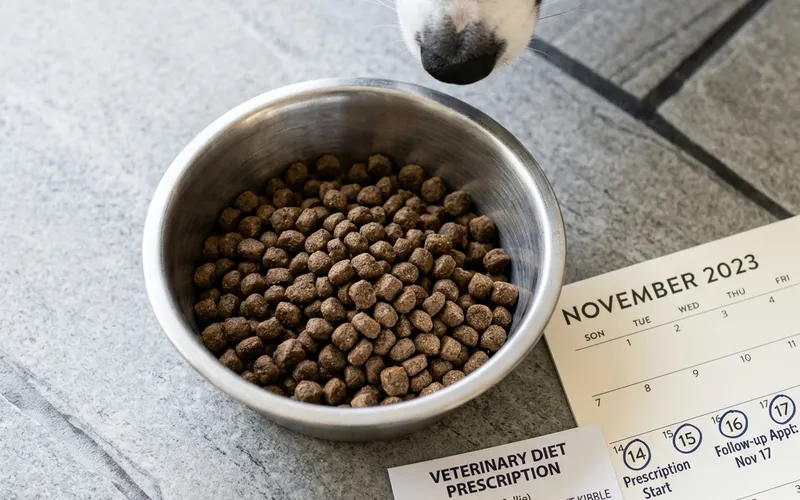
Clinical improvement on the trial diet alone is not a confirmed diagnosis. Once signs resolve, reintroduce the original diet. Return of signs within 7–14 days confirms food allergy. This rechallenge step distinguishes true food allergy from spontaneous improvement due to other factors.
Long-Term Management
Once a diagnosis is confirmed, management is straightforward in principle but requires lifelong commitment: permanently eliminate the offending ingredient(s) from the diet. Food allergy does not resolve spontaneously; immune memory persists.
Maintenance Diet Options
- Long-term novel protein diet: Sustainable with careful label reading. Some clinicians suggest rotating among multiple novel proteins over years to reduce the risk of developing new sensitivities, though the evidence for this rotation strategy remains limited.
- Long-term hydrolyzed protein diet: Viable for maintenance. Palatability varies by product and individual dog; monitor body condition and nutritional adequacy with your veterinarian.
The Role of Omega-3 Fatty Acids
Omega-3 supplementation (EPA + DHA) can help modulate skin inflammation and support barrier function as an adjunct therapy. A double-blind, placebo-controlled trial of 29 dogs (Mueller RS et al., 2004, Journal of Small Animal Practice) found significant clinical score improvement with EPA at 50 mg/kg/day and DHA at 35 mg/kg/day over 10 weeks.
However, the ACVD Task Force on Canine Atopic Dermatitis concludes that the evidence is currently insufficient to make a definitive recommendation for or against EFA supplementation for CAD symptom control (Olivry et al., 2010, Veterinary Dermatology). Omega-3 supplementation is an adjunct, not a replacement for dietary management.
A Note on Border Collies Specifically
There is currently no large-scale epidemiological study demonstrating that Border Collies develop food allergy at higher rates than other breeds (Picco F et al., 2008, a prospective study of 259 allergic dogs, did not identify a breed-specific predisposition). The clinical presentations and management principles described above apply broadly across breeds.
One condition worth keeping in mind for Border Collies is hypothyroidism, which can manifest with skin problems including dry coat, hair loss, and reduced resistance to secondary infection. Because hypothyroidism symptoms can overlap with food allergy signs, if dietary management fails to produce adequate improvement, thyroid function evaluation (total T4, ideally free T4 by equilibrium dialysis) is reasonable to discuss with your veterinarian.
What to Bring to the Veterinary Appointment
Providing structured information helps your veterinarian build an effective diagnostic and treatment plan more efficiently.
- Complete ingredient list of every food, treat, and supplement fed over the past 6+ months (longer is better)
- Timeline of when signs began and any pattern of improvement or worsening
- Presence or absence of seasonality
- Any gastrointestinal signs (vomiting, soft stool, diarrhea)
- All protein sources the dog has consumed historically — this determines what qualifies as “novel”
About ROSCH KENNEL: A specialist Border Collie breeder based in Kirishima, Kagoshima, Japan — elevation 750 m (2,460 ft) within the Kirishima-Kinkowan National Park. All breeding dogs undergo a minimum of 15 genetic health tests, with results published in full.
References
-
Olivry T & Mueller RS (2017). Critically appraised topic on adverse food reactions of companion animals (2): common food allergen sources in dogs and cats. BMC Veterinary Research. PMC4710035.
-
Verlinden A, Hesta M, Millet S, Janssens GP (2006). Food allergy in dogs and cats: A review. Critical Reviews in Food Science and Nutrition, 46(3), 259–273. PMID 16527756.
-
Picco F, Zini E, Nett C, et al. (2008). A prospective study on canine atopic dermatitis and food-induced allergic dermatitis in Switzerland. Veterinary Dermatology, 19(3), 150–155. PMID 18477331.
-
Olivry T & Bizikova L (2010). A systematic review of randomized controlled trials for prevention or treatment of atopic dermatitis in dogs. Veterinary Dermatology, 21(4), 310–332. PMID 19552700.
-
Mueller RS, Fieseler KV, Fettman MJ, et al. (2004). Effect of omega-3 fatty acids on canine atopic dermatitis. Journal of Small Animal Practice, 45(6), 293–297. PMID 15206474.
-
Olivry T, DeBoer DJ, Favrot C, et al. (2010). Treatment of canine atopic dermatitis: 2010 clinical practice guidelines from the International Task Force on Canine Atopic Dermatitis. Veterinary Dermatology, 21(3), 233–248.
-
U.S. Food & Drug Administration. Investigation into a Possible Connection Between Certain Diets and Canine Dilated Cardiomyopathy. FDA Animal & Veterinary.
Daily observation is where the next article begins.
Instagram shows the dogs in daily life. The journal turns the themes we notice there into evidence-aware resources.