
How Much Exercise Does a Border Collie Need? The Science of Quality and Quantity
One of the first walls new Border Collie owners hit is the exercise question. “I’m walking him an hour a day and he’s still bouncing off the walls.” “She comes home from a run and starts demanding more five minutes later.” These experiences aren’t unique — and they point to a fundamental misunderstanding of what this breed was built to do.
Border Collies were selectively bred over centuries as herding dogs. Their biological exercise demands reflect that history. Caring for them through the lens of an average companion dog is a mismatch from the start.
This article draws on peer-reviewed research and published veterinary guidelines to break down what Border Collies actually need — both in terms of physical output and mental engagement.
What Herding Dogs Actually Do: The Data
To understand the exercise needs of a Border Collie, it helps to start with the work they were designed for.
Researchers fitted working Australian Cattle Dogs (a closely related herding breed) with GPS heart rate monitors during live mustering sessions and measured their output directly (Lakhdhir et al., Equine and Comparative Exercise Physiology, Cambridge Core):
- Distance per session: 8.3–18.8 miles (13.3–30.2 km), over 2–4 hours
- Peak speed: 27.2 mph (43.7 km/h)
- Heart rate during work: 120–237 bpm, with 51–68% of work time above 180 bpm
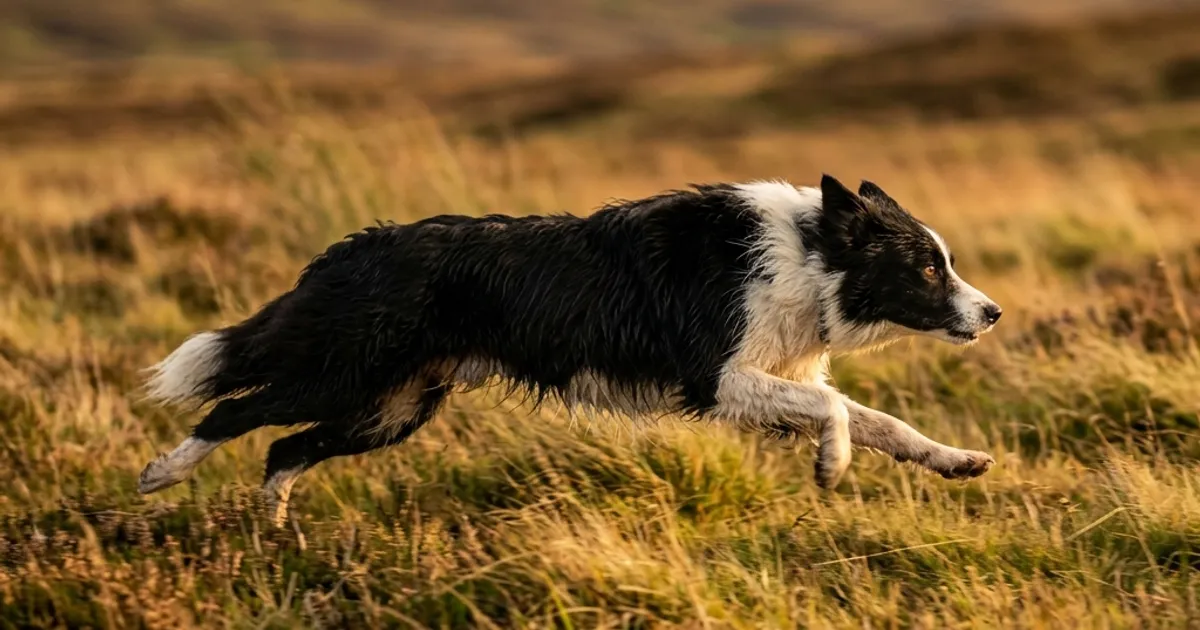
This isn’t a long walk. It’s high-intensity interval work — repeated sprinting, directional changes, and sustained effort — carried out across extended periods in summer heat (29–38°C / 84–100°F).
Border Collies were built to perform at this level. The take-home isn’t that pet dogs need to replicate these figures; it’s that the baseline capacity of the breed is extraordinary, and any care plan needs to acknowledge that reality.
Adult Exercise Recommendations
The UK’s PDSA (People’s Dispensary for Sick Animals) — one of the most authoritative animal welfare organizations — publishes the following for adult Border Collies:
“At least 2 hours of exercise per day. More is better. Split across multiple sessions, including time off-leash in a safe, open area.” — PDSA Official Care Guide
Note the word “minimum.” Two hours is the floor, not the ceiling. The recommendation to split sessions also matters: two 60-minute sessions tend to be more effective than one 120-minute block, both for physical recovery and behavioral satisfaction.
The Three Components of Quality Exercise
1. Aerobic base (daily) Off-leash running, hiking, and natural terrain work. Flat pavement walking alone is insufficient. Uneven ground and inclines develop core strength and proprioception in ways that structured walks cannot.
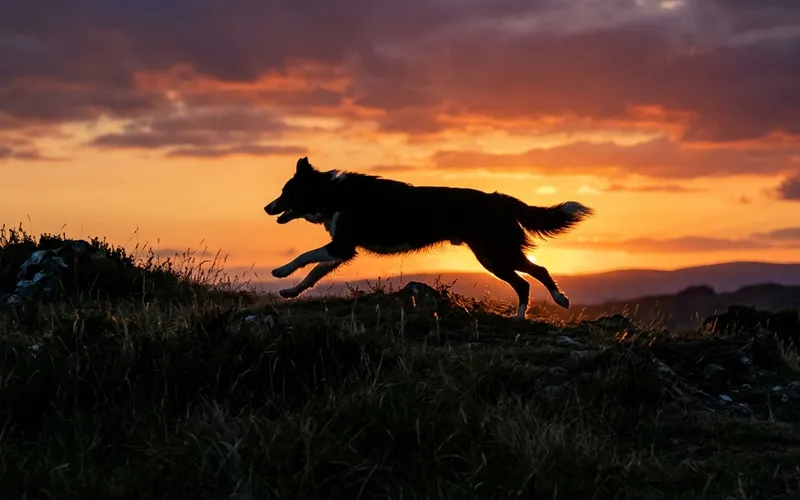
2. High-intensity bursts (3–4 times per week) Frisbee, controlled fetch, agility work. Sessions that bring heart rate to near-maximum for short intervals. This is what satisfies the breed’s sprint-and-recover physiology.
3. Mental engagement (daily) Covered in detail below — but physical output without cognitive challenge leaves Border Collies chronically understimulated.
Puppy Exercise Limits: Protecting the Growth Plates
Puppies have different needs, and overexercising them carries real risk.
Growth plates — the cartilaginous tissue at the ends of long bones responsible for skeletal growth — are the weakest structural point in a young dog’s skeleton. The surrounding ligaments and tendons are actually stronger than the plates themselves during this period. Damage to a growth plate can cause bone deformity, limb shortening, and lasting lameness.
The “5-minute rule” is the most widely recommended guideline: 5 minutes of leash walking per month of age, up to twice per day.
| Age | Max per session (leash walking) | Per day (2 sessions) |
|---|---|---|
| 2 months | 10 minutes | 20 minutes |
| 3 months | 15 minutes | 30 minutes |
| 4 months | 20 minutes | 40 minutes |
| 5 months | 25 minutes | 50 minutes |
| 6 months | 30 minutes | 60 minutes |
| 9 months | 45 minutes | 90 minutes |
A note on evidence: No randomized controlled trial has validated the 5-minute rule directly. However, the anatomical vulnerability of growth plates and the biomechanics of overload injury provide a sound biological rationale. It is widely adopted by veterinary professionals and kennel clubs including The Kennel Club (UK) as a reasonable precautionary guideline.
High-impact activities — repeated jumping, ball chasing — should be restricted until growth plates fully close, typically between 12 and 18 months (with individual variation).
The Gap Between Physical and Behavioral Maturity
Border Collies reach skeletal maturity at 12–18 months, but behavioral maturity continues until around 24 months. A dog that is physically full-grown may still be functionally adolescent in terms of impulse control and stress response. This period calls for continued patience in exercise design, even after the growth plate concern has passed.
Border Collie Collapse (BCC): A Genetic Risk to Know
Border Collie Collapse is a breed-specific condition characterized by sudden onset of neurological symptoms — disorientation, ataxia, an exaggerated high-stepping gait — that appears 5–15 minutes into intense exercise and resolves fully within 5–30 minutes of rest.
A 2021 study by Norton et al. published in Genes (Vol. 13, No. 1; PubMed PMID: 34946876) confirmed BCC has substantial heritability (h²SNP = 49–61%) and involves at least 2,407 SNPs across multiple chromosomes. It is a polygenic trait with a confirmed genetic architecture.
The most common triggers are ball chasing (68% of episodes) and herding (24%), according to owner survey data from Minor et al. and Taylor et al. (both 2016, Journal of Veterinary Internal Medicine, PubMed PMIDs: 27487345, 27685362).
BCC is not life-threatening. However, dogs with a history of collapse episodes should have exercise designed to avoid sustained high-excitement activity, and owners should learn to recognize the early warning signs — wobbly rear legs, decreased responsiveness — before full collapse occurs.
Mental Stimulation: Why Physical Exercise Alone Is Not Enough
There is a structural reason that a tired Border Collie isn’t the same as a satisfied one.
Herding dogs were bred not just to run, but to make rapid, complex decisions: reading animal movement, anticipating direction changes, working in coordination with a handler. The cognitive load of that work is inseparable from the physical output. A dog that runs two hours but is never asked to think hasn’t had its full needs met.
A large-scale study of 3,264 dogs by Tiira & Lohi (2015, University of Helsinki) found that dogs receiving less exercise showed significantly higher rates of noise sensitivity and separation anxiety — noise sensitivity at p<0.0001, separation anxiety at p=0.007 (PLOS ONE, 10(11): e0141907; PMC4631323). Exercise and behavioral stability are directly linked.
Practical Mental Engagement
Daily cognitive load:
- Nosework (scent-based search training)
- Short trick training sessions (5–10 minutes, with new material regularly introduced)
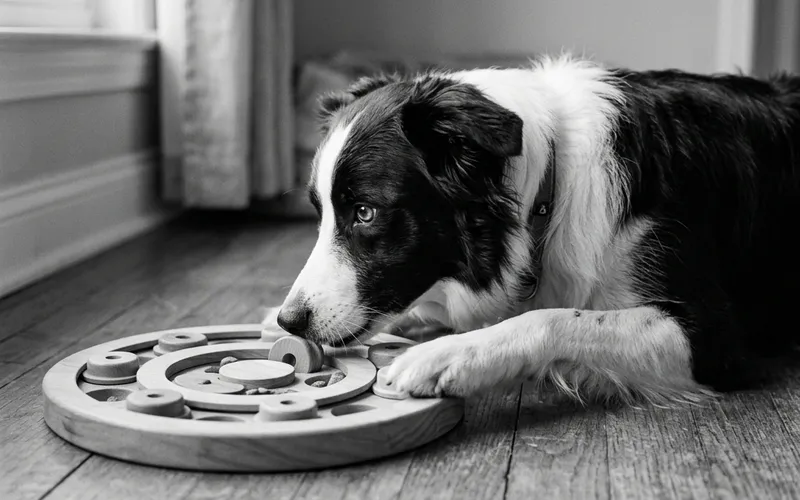
- Interactive puzzle feeders at mealtimes
Combined physical and cognitive work (2–3 times per week):
- Agility courses (sequencing, spatial judgment, and physical output combined)
- Flyball or disc dog
- Herding ball work (engages instinctive drive without livestock)
Sniffing-led walks (integrated into daily routine):
- Allow the dog to set the pace and follow its nose on at least one walk per day
- Olfactory engagement produces measurable mental fatigue and is under-utilized by most owners
Senior Dogs: Adjusting for an Aging Working Breed
Dogs are generally considered senior at around 7 years, but Border Collies tend to remain active well into their senior years. This creates a specific challenge.
Working and herding breeds are known to continue working despite pain or injury. A senior Border Collie may appear enthusiastic while carrying a developing joint issue. Relying solely on the dog’s apparent willingness is insufficient in this life stage.
Recommended adjustments:
- Divide one long session into two or three shorter sessions
- Introduce low-impact alternatives: swimming, hill walking on gentle terrain, controlled leash walks
- Avoid repeated jumping from height and hard cornering at speed
- Add dedicated warm-up and cool-down time around each session
Reduce or stop when you observe:
- Lameness during or after exercise
- Stiffness the morning after activity
- Excessive panting disproportionate to conditions
- Reluctance to start — lying down and refusing to move
Recognizing Underexercise
Regardless of the numbers, the dog in front of you is the best data source.
Behavioral indicators:
- Pacing and circling indoors
- Persistent demand vocalizing or barking
- Destructive behavior — furniture, baseboards, doors
- Repetitive foot or leg licking (a stress behavior)
- Increased reactivity toward people or other dogs
Physical indicators:
- Weight gain; ribs no longer easily palpable
- Loss of muscle tone and body condition
- Joint stiffness on rising
These signs indicate the current exercise regime is not meeting the dog’s needs. That said, behavioral problems are multi-causal — health issues and socialization gaps can produce similar presentations. Veterinary consultation alongside management changes is the appropriate approach.
Summary: Exercise as a System, Not a Number
| Life Stage | Key Approach |
|---|---|
| Puppy (up to 12 months) | 5-minute rule × 2 daily. No high-impact activity until growth plates close |
| Adolescent (12–24 months) | Transition to adult volume, but allow for behavioral immaturity |
| Adult (2–7 years) | Minimum 2 hours/day. Combine off-leash aerobic work, high-intensity bursts, and cognitive engagement |
| Senior (7+ years) | Increase frequency, reduce duration. Shift to low-impact. Prioritize pain monitoring |
Border Collie exercise needs are not arbitrary — they reflect the biological legacy of a working dog built for sustained, intelligent physical effort. The goal isn’t to exhaust the dog. It’s to meet a genuine need with a thoughtful, science-informed approach.
About ROSCH KENNEL: A Border Collie specialty breeder based at 2,461 ft (750 m) elevation within Kirishima Kinkowan National Park, Kagoshima, Japan. All breeding dogs undergo 15+ panel genetic health testing, with results published in full.
References
-
Lakhdhir, S. et al. “Physiological responses of the Australian cattle dog to mustering exercise.” Equine and Comparative Exercise Physiology. Cambridge University Press.
-
Norton, E.M. et al. (2021). “Heritability and Genomic Architecture of Episodic Exercise-Induced Collapse in Border Collies.” Genes, 13(1). PubMed PMID: 34946876 / PMC8701027.
-
Minor, K.M. et al. (2016). “Evaluation of Dogs with Border Collie Collapse, Including Response to Two Standardized Strenuous Exercise Protocols.” Journal of Veterinary Internal Medicine. PubMed PMID: 27487345.
-
Taylor, S.M. et al. (2016). “Border Collie Collapse: Owner Survey Results and Veterinary Description of Videotaped Episodes.” Journal of Veterinary Internal Medicine. PubMed PMID: 27685362.
-
Tiira, K. & Lohi, H. (2015). “Early Life Experiences and Exercise Associate with Canine Anxieties.” PLOS ONE, 10(11): e0141907. PMC4631323.
-
PDSA. “Border Collie care guide.” People’s Dispensary for Sick Animals (UK).
-
The Kennel Club (UK). “Border Collie.” thekennelclub.org.uk.
Daily observation is where the next article begins.
Instagram shows the dogs in daily life. The journal turns the themes we notice there into evidence-aware resources.