

The ENS (Early Neurological Stimulation) Program — Evolving Puppy Rearing Alongside Science
Origins of the ENS Program
The ENS (Early Neurological Stimulation) program is said to have originated from U.S. military Bio Sensor Research. In the late 1960s to early 1970s, the military investigated how gentle stress stimuli applied to neonatal puppies might affect nervous system development — aimed at maximizing the capabilities of military working dogs. The program, colloquially known as “Super Dog,” was reportedly conducted at military research facilities against the backdrop of the Vietnam War-era canine enhancement program.
Initial reports indicated that dogs receiving ENS showed the following improvements compared to control groups:
- Cardiovascular strengthening — Improved heart rate and adrenal function
- Enhanced stress tolerance — Better adaptability to novel environments and situations
- Immune system strengthening — Increased disease resistance
- Improved learning capacity — Faster acquisition during training
This research was subsequently popularized in the civilian breeding community by Dr. Carmen Battaglia through the “Breeding Better Dogs” program, and is now practiced by breeders worldwide.
The Theoretical Foundation of ENS
Why would stimulation of a days-old puppy — whose eyes and ears haven’t even opened — influence development?
The underlying concept is neural plasticity.
The canine nervous system begins rapid development immediately after birth. The period from postnatal day 3 to day 16 is characterized by active synapse formation between neurons, and gentle stress applied during this window is theorized to influence adrenal cortex development.
The adrenal cortex regulates production of stress hormones (cortisol). Theoretically, puppies receiving appropriate stimulation during this period develop more efficient stress response circuits, resulting in dogs that more readily adapt to environmental changes.
The Five Stimulation Exercises
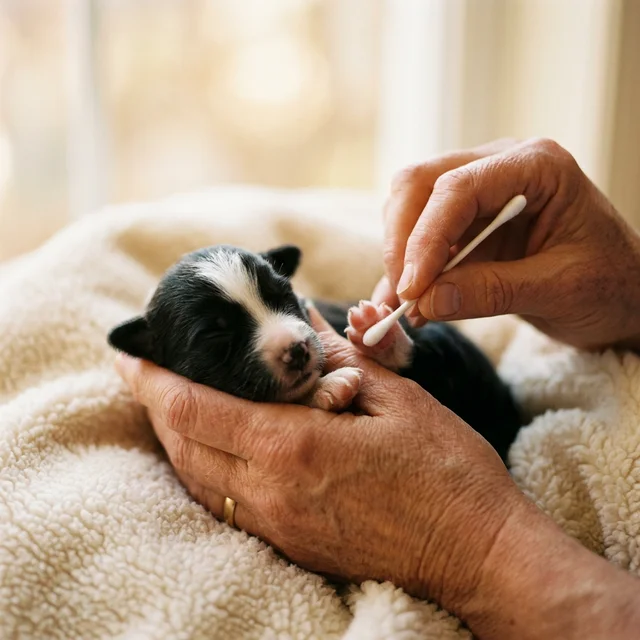
The ENS program consists of five stimulation exercises performed on each puppy once daily, each lasting 3–5 seconds.
1. Tactile Stimulation
Using a cotton swab to gently stimulate the puppy’s paw pads (between the toes). This engages tactile development and neural reflex patterns.
2. Head Held Erect
Supporting the puppy with both hands and holding it vertically with head up. This stimulates the vestibular system (balance sense) against gravity.
3. Head Pointed Down
Holding the puppy inverted with head pointing downward. This also stimulates the vestibular system, but in the opposite gravitational orientation.
4. Supine Position
Holding the puppy on its back, supported by both hands. This posture represents a vulnerable position in nature, inducing a mild stress response.
5. Thermal Stimulation
Placing the puppy on a cool, damp towel for 3–5 seconds. This stimulates neural circuits involved in thermoregulation.
Implementation Guidelines
The ENS program is not a case of “more is better.” The following principles are strictly observed:
- No more than once daily — Excessive stimulation can be counterproductive
- Each exercise: 3–5 seconds — Longer durations risk excessive stress
- Order doesn’t matter — But all five must be performed
- Skip puppies with health issues — Additional stress during illness is avoided
- Minimize separation from the dam — The complete exercise set should be completed within 2–3 minutes
What Recent Research Shows — The State of the Evidence
Since our founding, ROSCH KENNEL has consistently performed the ENS program on every puppy born at our facility. At the time, it represented what we judged to be the best course of action based on available information.
However, we must be upfront about something. Recent peer-reviewed research has produced mixed findings on ENS effectiveness.
Multiple studies from various research institutions have reported finding no statistically significant differences in developmental parameters between ENS puppies and those receiving only standard handling. Additionally, emerging evidence suggests that in environments already implementing comprehensive socialization programs, the incremental benefit of ENS alone may be limited.
On the other hand, clinical reports supporting ENS efficacy do exist, as does extensive practical knowledge accumulated within the breeder community over decades. The effects originally reported by the military program are also a matter of record.
The bottom line: scientific consensus has not been established at this time.
Why We Continue ENS — and Why We Keep Questioning
Abandoning a practice simply because the evidence is mixed would be equally hasty. ROSCH KENNEL continues ENS for three reasons:
- No harm: When performed according to protocol, no adverse effects on puppies have been reported
- Habituating daily handling: The ENS routine naturally ensures dedicated one-on-one time with each puppy from the earliest postnatal days
- Observation opportunity: Daily hands-on contact with every puppy enables early detection of health changes or developmental delays
At the same time, we do not treat ENS as infallible dogma. We stay current with the latest research, factor in changes to our own rearing environment, and continue searching for better methods. Science, as we see it, is not about locking in answers — it’s about continuing to ask questions.
Beyond ENS — The Two Factors That Define a Dog’s Life
The ENS program is one component of puppy development; others include sensory enrichment, socialization, and temperament evaluation. But even accounting for everything a kennel provides, the two elements that most profoundly shape a dog’s entire life can be distilled to just two.
1. DNA — The Genetic Foundation

No amount of environmental optimization can eliminate the risk of hereditary disease. Conversely, a genetically sound foundation is what allows environmental factors to reach their full potential.
That’s why ROSCH KENNEL conducts 15-item DNA testing on all breeding dogs and eliminates carrier × carrier pairings. Before ENS, before socialization, genetic risk has to be understood.
However, DNA testing only covers mutations with identified causative genes — roughly one-quarter of known canine hereditary diseases. Conditions like epilepsy and Border Collie Collapse (BCC) remain undetectable by DNA testing. Testing is a minimum benchmark; beyond it, the breeder’s powers of observation and accumulated experience are what matter. Moreover, epigenetics — changes in gene expression driven by nutrition, stress, and environment — directly impacts canine health yet lies fundamentally beyond DNA testing’s reach.
2. Life After Placement — Living with the Owner

The 8–10 weeks a puppy spends at the kennel represents just 2% of its life. The remaining 98% is in the owner’s hands.
Continued socialization, adequate exercise and mental stimulation, a secure home environment, a working relationship with a trusted veterinarian — sustaining physical and psychological wellbeing over a lifetime is built through the accumulation of daily care.
No matter how strong a start we provide, there’s work that only the owner can do from that point forward. That’s why ROSCH KENNEL doesn’t treat placement as a transaction. Ongoing support after the puppy goes home is something we take seriously.
Walking Alongside Science
Adopting the ENS program reflects one facet of ROSCH KENNEL’s philosophy: breeding that doesn’t rely on intuition alone. But the essence of science is “questioning what was believed to be right and continuing to update.”
What can be measured, we measure. When evidence changes, protocols have to change with it. And we maintain the courage to question yesterday’s assumptions.
Whether ENS ultimately proves to be the optimal approach, further research will tell. When that moment comes, we stand ready to update our protocols based on new evidence. What will never change is the commitment to always choosing what’s best for the dogs.
Science itself is always evolving, and the best choice for the dog has to be re-evaluated with it.
Daily observation is where the next article begins.
Instagram shows the dogs in daily life. The journal turns the themes we notice there into evidence-aware resources.