

Nutrition During Growth — Choosing the Right Food and Homemade Topping Recipes for Puppies
Nutrition During the Growth Period Shapes the Entire Life
A Border Collie puppy reaches adult size between 12 and 18 months. The quality and quantity of nutrients consumed during this rapid growth phase directly influence skeletal development, muscle formation, immune system maturation, and even brain development.
Growth-stage nutrition management isn’t simply about “choosing a good food.” It’s an ongoing process of optimization, continuously adjusted to the individual dog’s conformation, activity level, and health status.
Balancing Core Nutrients
The essential nutrient ratios for a growing Border Collie puppy are as follows.
Protein
- Recommended ratio: 25–30% of total calories
- Animal-based protein sources should predominate (chicken, lamb, fish)
- Essential for muscle development and immunoglobulin production
Fats
- Recommended ratio: 15–20% of total calories
- Omega-3 fatty acids (DHA/EPA) contribute to brain development
- Quality sources: Salmon oil, flaxseed oil
Calcium and Phosphorus
- Ideal Ca:P ratio: 1.2:1 to 1.4:1
- Larger breeds require particular vigilance against calcium excess
- While the Border Collie is a medium-sized breed (adult weight 30–48 lbs / 14–22 kg), excessive calcium can cause abnormal bone growth
Criteria for Choosing a Commercial Food
When selecting a commercial dog food, the following criteria serve as a useful guide.
Key Checkpoints
- AAFCO (Association of American Feed Control Officials) compliance — Must be formulated for “growth” or “all life stages”
- Animal protein as the primary ingredient — Meat (chicken, lamb, etc.) should be listed first on the ingredient label
- No artificial preservatives — Avoid chemical preservatives such as BHA, BHT, and ethoxyquin
- Grains: not inherently bad — Grain-free is not automatically superior. Easily digestible grains (brown rice, oatmeal) serve as beneficial energy sources
Ingredients to Avoid
- Products listing meat by-products as the primary ingredient
- Added sugar or artificial coloring
- Vague “meal” quality designations with no clear sourcing
Homemade Topping Recipes
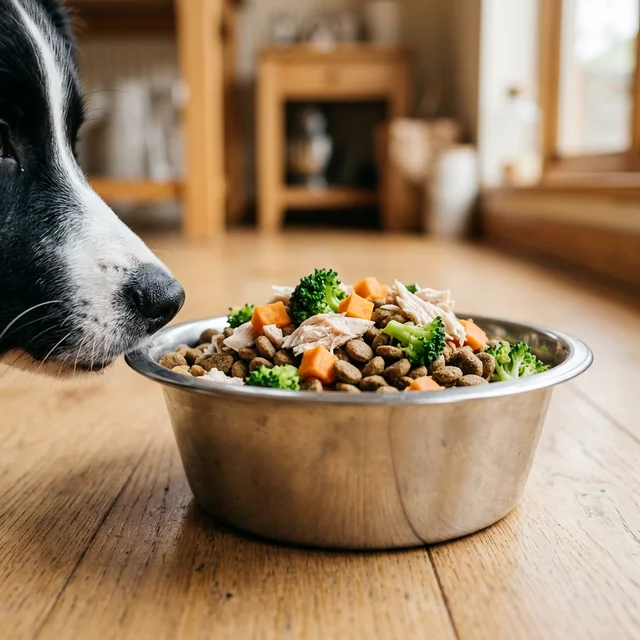
Using a quality dry kibble as a base and adding human-grade ingredient toppings achieves both nutritional balance and mealtime enrichment.
Basic Topping: Steamed Chicken and Vegetables
Ingredients (per serving):
- Chicken breast: 1 oz (30 g)
- Sweet potato: 0.5 oz (15 g)
- Broccoli: 0.35 oz (10 g)
- Carrot: 0.35 oz (10 g)
Method:
- Steam the chicken breast and shred finely
- Dice the vegetables small and steam until tender
- Top the dry kibble
- Cool to body temperature before serving
Omega-3-Enriched Topping
Ingredients:
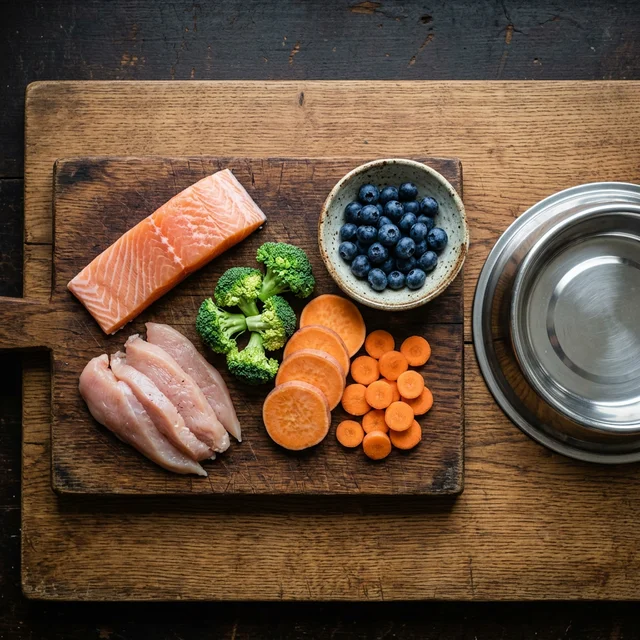
- Sashimi-grade salmon: 0.7 oz / 20 g (cooked)
- Ground sesame: ½ teaspoon
- Blueberries: 3–4
Salmon must always be cooked. Raw fish contains thiaminase (vitamin B1-destroying enzyme).
Life Stage Feeding Guidelines

2–4 Months
- Feeding frequency: 3–4 times daily
- Food consistency: Softened with warm water → gradually transition to dry
- Note: Growth rate peaks during this period. Monitor weight weekly
4–8 Months
- Feeding frequency: 3 times daily
- Calories: Per-pound caloric needs reach their peak
- Note: Teething period. Avoid excessively hard treats
8–12 Months
- Feeding frequency: Transition to 2 times daily
- Calories: Growth rate slows, caloric needs gradually decrease
- Note: Observe body condition carefully; watch for weight gain tendencies
12+ Months
- Food transition: Gradually switch from puppy to adult formula (blend ratios over 7–10 days)
- Feeding frequency: Maintain 2 times daily
Foods That Must Never Be Fed
The following foods are toxic to dogs and must never be given:
- Chocolate — Theobromine toxicity
- Onions, garlic, and alliums — Destroys red blood cells
- Grapes and raisins — Can cause acute kidney failure
- Xylitol — Even small amounts can trigger hypoglycemia and liver failure
- Cooked chicken bones — Splinter into sharp fragments that can lacerate the digestive tract
- Avocado — Persin toxicity
ROSCH KENNEL’s Nutrition Philosophy
At ROSCH KENNEL, every dog receives daily homemade toppings using human-grade ingredients. With quality dry kibble as a base, we combine seasonal and locally sourced ingredients — including produce from the Kirishima region — to nourish both the body and the joy of eating.
Nutrition management has no endpoint. Adjustments continue day by day in response to each dog’s age, weight, activity level, and health status. That ongoing refinement is simply part of what it means to live with dogs.
Daily observation is where the next article begins.
Instagram shows the dogs in daily life. The journal turns the themes we notice there into evidence-aware resources.