


The Role of DNA Testing — A Minimum Benchmark for Border Collie Health Management
What DNA Testing Is — and What It Is Not

The Border Collie is renowned as the world’s most intelligent dog breed, yet it also carries risk for several hereditary conditions. Most are inherited through autosomal recessive patterns, meaning outwardly healthy “carriers” silently pass genetic mutations to the next generation.
When two carriers are bred together, statistically approximately 25% of offspring will be affected — and some of these conditions are fatal. DNA testing is a supplementary tool that makes these invisible risks visible for known genetic mutations.
But there’s something we must be forthright about. An estimated 700 to 900 hereditary diseases exist in dogs, yet science has identified the causative gene for only about 200 (roughly one-quarter). DNA testing illuminates part of a dog’s genetic health landscape — not all of it.
At ROSCH KENNEL, we perform 15 genetic tests on every breeding dog, centered on Orivet’s Border Collie-specific panel. Results are published and used in pairing decisions. But testing is a starting point — never a destination.
Key Hereditary Conditions in Border Collies
The following are the primary genetic tests performed at ROSCH KENNEL.
CEA (Collie Eye Anomaly / Choroidal Hypoplasia)
- Causative gene: NHEJ1 (intron deletion)
- Inheritance: Autosomal recessive (with incomplete penetrance)
- Symptoms: Developmental abnormalities of the retina and choroid. Mild cases may not affect vision, but severe cases can lead to retinal detachment and blindness.
- Breeding management: Carrier × carrier breeding is prohibited. DNA testing is supplemented with ophthalmic examination.
CEA is one of the most prevalent hereditary eye conditions in Border Collies. Due to incomplete penetrance, some dogs with the affected genotype (homozygous mutants) appear clinically normal — making detection impossible without testing.
TNS (Trapped Neutrophil Syndrome)
- Causative gene: VPS13B
- Inheritance: Autosomal recessive
- Symptoms: A severe immune system defect. Neutrophils fail to release from the bone marrow into the bloodstream, leaving the dog extremely vulnerable to infection.
- Breeding management: Fatal condition. Carrier identification is mandatory.
Puppies affected by TNS suffer chronic infections, and most die young. The condition is invisible externally, making pre-breeding DNA testing the only means of prevention.
CL (Neuronal Ceroid Lipofuscinosis)
- Causative gene: CLN5
- Inheritance: Autosomal recessive
- Symptoms: A progressive neurodegenerative disease. Behavioral changes, vision loss, and ataxia progress, ultimately leading to premature death.
- Breeding management: Affected dogs die early. Carrier management is essential.
CL has no cure. Once clinical signs appear, the dog’s quality of life deteriorates severely. Preventing carrier × carrier breeding is the only path to eradicating this disease.
MDR1 (Multidrug Sensitivity)
- Causative gene: ABCB1 (formerly MDR1)
- Inheritance: Autosomal recessive (with incomplete dominance — heterozygotes may show mild sensitivity)
- Symptoms: Hypersensitivity to certain drugs including ivermectin. Severe cases result in neurotoxicity and death.
- Breeding management: Significant pharmaceutical risk. Testing is essential not only for breeding decisions but also for clinical care.
MDR1 is not merely a breeding consideration — it’s critical information for every Border Collie owner. Even carrier dogs face potential adverse reactions to certain medications. Sharing test results with your veterinarian is strongly recommended.
DM (Degenerative Myelopathy)
- Causative gene: SOD1
- Inheritance: Autosomal recessive with incomplete penetrance (multifactorial)
- Symptoms: Progressive spinal cord degeneration manifesting in middle-to-senior years. Hind limb paralysis advances gradually.
- Breeding management: Carrier status is tracked. Breeding decisions require careful consideration.
DM demonstrates incomplete penetrance — homozygous mutants do not inevitably develop clinical disease. However, recording and managing carrier information across breeding lines remains essential for minimizing risk.
PLL (Primary Lens Luxation)
- Causative gene: ADAMTS17 (though the specific causative mutation for Border Collies has not been identified)
- Inheritance: Autosomal recessive
- Symptoms: Weakening of the fibers supporting the lens, causing lens dislocation. May trigger secondary glaucoma and lead to blindness.
- Breeding management: A cause of blindness. Carrier breeding should be avoided.
- ⚠️ Important note: Commercially available PLL DNA tests target a mutation found in terrier breeds. The causative mutation for PLL in Border Collies remains unidentified. Therefore, PLL in Border Collies can only be evaluated through ophthalmic examination.
Additional Test Items
In addition to the above, ROSCH KENNEL also tests for:
- Cystinuria (SLC3A1) — Urinary stone risk in males
- Sensory neuropathy — Tested individually outside standard panels
- IGS (Imerslund-Gräsbeck Syndrome / Selective cobalamin malabsorption)
- SN (Sensory Neuropathy)
- Gliotoxin sensitivity
- EIC (Exercise-Induced Collapse)
How to Read Test Results
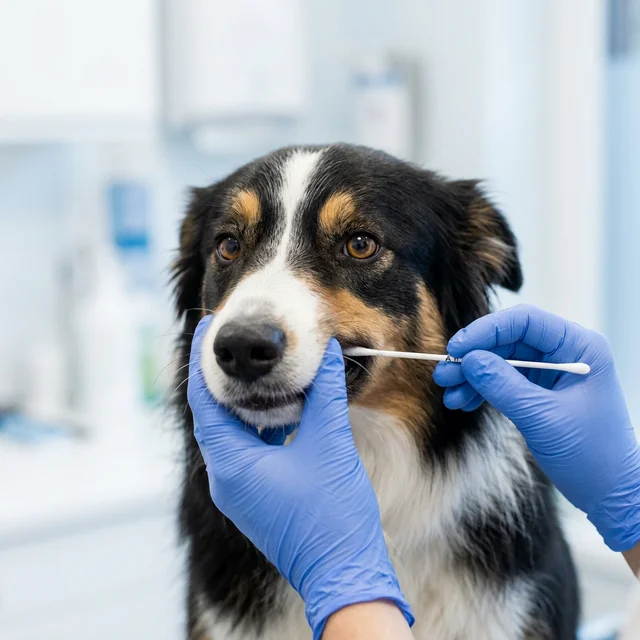
Genetic test results typically fall into three categories:
| Result | Notation | Meaning |
|---|---|---|
| Clear | Clear / N/N | No mutant alleles present. No risk of developing the condition. |
| Carrier | Carrier / N/M | One copy of the mutant allele present. The dog will not develop the condition but may pass the mutation to offspring. |
| Affected | Affected / M/M | Two copies of the mutant allele present. High risk of developing or having already developed the condition. For conditions with incomplete penetrance, may be strategically paired with a Clear dog under a planned breeding program. |
Breeding Combinations and Probabilities
| Breeding Pair | Clear Puppies | Carrier Puppies | Affected Puppies |
|---|---|---|---|
| Clear × Clear | 100% | 0% | 0% |
| Clear × Carrier | 50% | 50% | 0% |
| Carrier × Carrier | 25% | 50% | 25% |
| Affected × Clear | 0% | 100% | 0% |
As this table shows, carrier × carrier breeding theoretically produces affected offspring 25% of the time. ROSCH KENNEL does not perform carrier × carrier breeding, eliminating this risk entirely.
Coat Color-Related Genetic Testing
Beyond hereditary disease screening, analysis of coat color loci carries significant implications — particularly the merle gene (M locus), which has direct health consequences.
M Locus (Merle)
Double merle (M/M) dogs face extremely high risk of hearing and visual impairment. Strict rules govern merle breeding, with the fundamental principle being maintenance of the heterozygous (M/m) state.
Other Coat Color Loci
- E locus — Red/cream color expression
- D locus — Blue (dilute) color expression
- K locus — Solid color vs. pattern
- A locus — Tricolor, tan point, and other patterns
- S locus — White marking extent
- B locus — Chocolate/brown expression
Coat color genetic testing serves not only to predict expected puppy colors but also to prevent merle-related health risks — making it indispensable.
The Limits of Testing — A Breeder’s True Responsibility
In recent years, genetic testing has become increasingly popular in Japan’s dog breeding community. Testing adoption in itself is welcome, but the equation “tested = perfectly healthy” simply does not hold.
Even limiting discussion to Border Collies, significant health risks exist that DNA testing cannot detect:
- Idiopathic epilepsy: Prevalence in Border Collies ranges from 3–20%. Believed to be polygenic, but causative genes remain unidentified — no DNA test exists.
- Border Collie Collapse (BCC): Limb weakness following intense exercise. Cause unknown; diagnosis is by exclusion only.
- Early Adult-Onset Deafness (EAOD): Hearing loss manifesting between ages 2–6. No DNA test exists.
- Hip and elbow dysplasia: Multifactorial conditions influenced by both genetics and environment (nutrition, exercise levels, etc.). Physical examination (palpation) is performed, but DNA testing alone cannot assess these conditions.
Furthermore, epigenetics must not be overlooked. Even with identical DNA sequences, factors like nutrition, stress, rearing environment, and socialization quality all influence gene expression. Research published in Frontiers in Genetics has shown that canine temperament is more accurately predicted by differences in the DNA methylome (epigenetic modifications) than by DNA sequence variation alone.
In short, a dog’s health cannot be safeguarded by DNA testing alone. A breeder’s daily observation, the quality of the rearing environment, and the commitment to placing every puppy through in-person meetings — these are what constitute genuine health management, beyond what any test report can provide.
ROSCH KENNEL’s Breeding Philosophy
If it can be measured, we measure it. What data cannot capture, we protect through our own eyes, hands, and experience.
- 15-item DNA testing on all breeding dogs — This is the minimum standard
- Carrier × carrier breeding is never performed — Eliminating known hereditary disease risk
- 100% public disclosure of all test results — No compromises on transparency
- HD/ED (hip and elbow) palpation assessment on all dogs — Addressing multifactorial conditions beyond DNA testing’s reach
- Coefficient of Inbreeding management to maintain genetic diversity — Preventing new problems arising from excessive selection
- Ongoing research and observation of conditions not covered by DNA testing — For the domains testing cannot protect
- Every puppy is placed through an in-person meeting — Health management begins with the commitment of face-to-face placement
Testing is the starting line of responsibility, not the finish line. We follow the substance, not the trend. Only when genetic testing is combined with clinical health examinations, behavioral assessment, environmental optimization, and in-person placement does a breeding program truly stand on solid ground.
Use what testing can reveal, and manage the rest through observation, environment, and clinical judgment. That is the breeding standard ROSCH KENNEL works from.
Daily observation is where the next article begins.
Instagram shows the dogs in daily life. The journal turns the themes we notice there into evidence-aware resources.