

Puppy Socialization — The Critical Window from 3 to 16 Weeks
What Socialization Means
“Socialization” in dogs refers to the process of exposing a young puppy to a wide range of stimuli — people, other animals, sounds, environments — and allowing it to learn that these are safe. Dogs with inadequate socialization are statistically more likely to exhibit fearfulness, aggression, and overexcitement as adults.
Because the Border Collie possesses exceptionally high intelligence, it is also extraordinarily responsive to environmental stimuli. Without proper socialization, that sharp intellect can work in negative directions, manifesting as hypervigilance and excessive environmental reactivity.
The Socialization Timeline
Socialization is most effective when aligned with a puppy’s developmental stages.
Neonatal Period (0–2 Weeks)
With eyes and ears still closed, the puppy’s world during this period consists entirely of contact with its dam and littermates. However, at ROSCH KENNEL, we begin the ENS (Early Neurological Stimulation) program during this period. Gentle stimulation exercises performed from postnatal day 3 through day 16 are believed to have a positive influence on future nervous system development.
Transitional Period (2–3 Weeks)
Eyes begin to open and ears start to function. From this point, tactile and auditory stimuli are gradually introduced.
Socialization Period (3–16 Weeks)
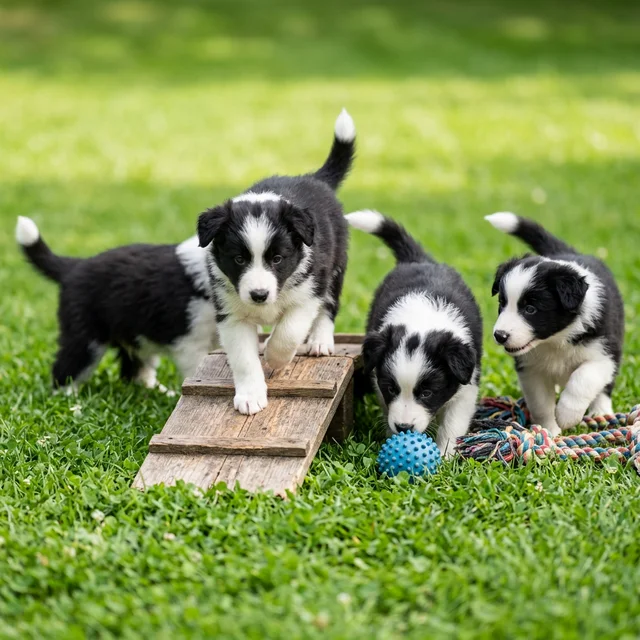
The single most important developmental window. Experiences missed during this period risk becoming sources of “fear of the unknown” for the rest of the dog’s life.
At ROSCH KENNEL, the following stimuli are introduced systematically:
- People: Men, women, children, individuals wearing hats or sunglasses
- Animals: Other dogs (supervised interaction with adults), cats
- Environmental sounds: Vacuum cleaners, car engines, recorded thunder, fireworks
- Surfaces: Grass, gravel, concrete, metal platforms, puddles
- Locations: Indoor spaces, outdoor fields, forest settings, inside vehicles
Juvenile Period (4–6 Months)
The stage for reinforcing and maintaining the experiences gained during the socialization window. Outings to new places and play with other dogs continue.
ROSCH KENNEL’s Socialization Program
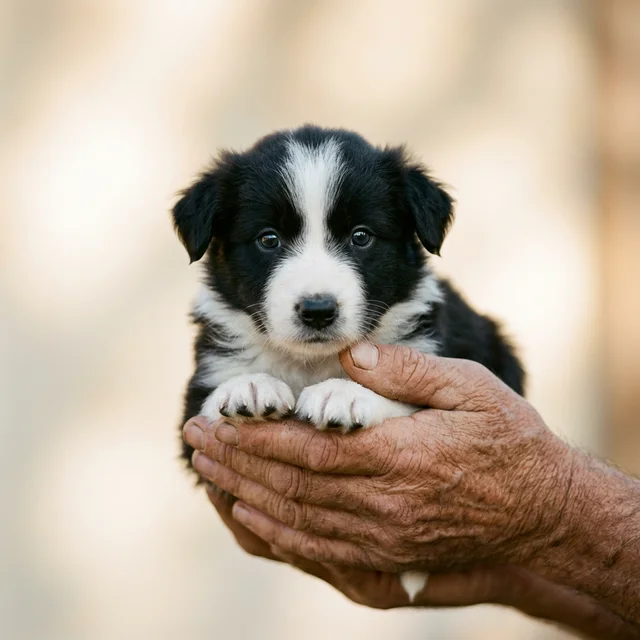
Step 1: ENS Program (Days 3–16)
The ENS program, based on the U.S. military’s Bio Sensor Research, is performed on every litter. Five gentle stimulation exercises, each lasting 3–5 seconds, are expected to have positive effects on stress tolerance and immune function. The daily routine of handling each puppy individually also serves as an opportunity to detect early changes in health or developmental progress.
Step 2: Sensory Enrichment (Weeks 3–5)
- Placing toys of varying materials and textures in the whelping box
- Playing classical music and environmental sound recordings at low volume
- Walking practice on different surfaces (towels, rubber mats, wooden boards)
Step 3: Human Interaction (Weeks 4–8)
- Daily individual handling (touching each body part)
- Contact with people of varying ages and genders
- Introduction to gentle grooming
Step 4: Environmental Exposure (Weeks 6–12)
- Outdoor experiences utilizing Kirishima’s natural environment
- Water play (shallow puddles → small streams)
- Short-distance car rides
- Supervised play with other dogs
Caution: The Risk of Over-Socialization
Socialization is essential, yet “more stimuli equals better outcome” is a misconception. What matters is quality, not quantity.
Excessive stimulation or experiences that frighten the puppy will backfire. The two guiding principles are: allow the puppy to explore new stimuli at its own pace, and ensure each experience is stored in memory as a positive one.
If a puppy shows stress signals — yawning, scratching itself, averting its gaze, attempting to move away — stop immediately. Never push through.
Continuing Socialization After Placement
ROSCH KENNEL provides every new owner with detailed socialization guidelines for the post-placement period. What we do at the kennel is the start, not the finish.
Adapting to a new home environment — the postal carrier, the neighbor’s dog barking, the vacuum cleaner — is a process that rests in the owner’s hands.
There are no shortcuts with socialization. But with proper knowledge and well-timed intervention, a dog is better equipped to adapt to new environments and live steadily with people.
Daily observation is where the next article begins.
Instagram shows the dogs in daily life. The journal turns the themes we notice there into evidence-aware resources.